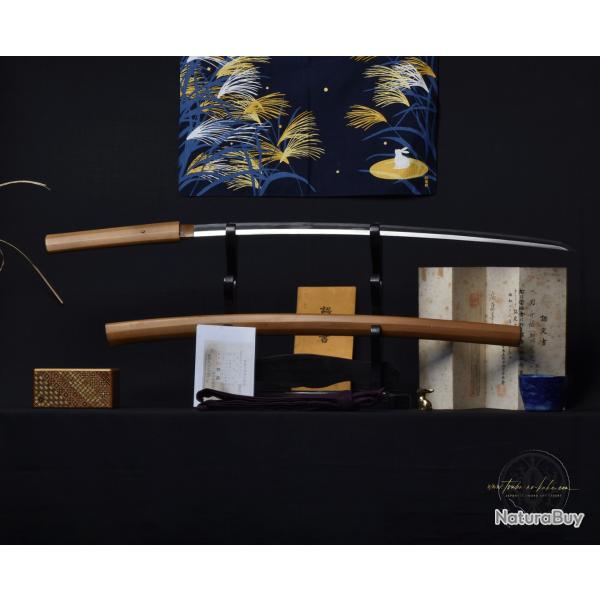
Katana – Attributed to Kashu Ietsugu / Kaga Aoe School – Late Muromachi Period
This katana is stylistically attributed to one of the Ietsugu (??) smiths of the Kaga Aoe school, a lineage active from the Muromachi into the Edo period. Its sugata, curvature and overall proportions indicate a production date in the late Muromachi period, approximately between 1500 and 1573. Based on these characteristics, several smiths of the Ietsugu line are considered probable candidates
.
One possibility is Ietsugu of the Daiei era (1521–1528), known under signatures such as “Kash? Nomi-gun-j? Sh?gen Ietsugu”, “Kash? Nomi-gun-j? Ietsugu saku”, and “Sh?gen Ietsugu”. He belonged to the Kaga Aoe school and worked in the Nomi District of Kaga province.
Another likely candidate is the Ietsugu active during the K?ji era (1555–1558). His known signatures include “Ietsugu”, “Kash?-j? Fujiwara Ason Ietsugu saku”, and “Kash? Fujiwara Ietsugu saku”. He is associated with the Hashizume group of the Kaga Aoe tradition. Works from this smith are documented from the Tenbun period (1532–1555) through the Eiroku period (1558–1570). His hamon styles often include suguha mixed with ch?ji and gunome-midare. He is classified as wazamono and ch?-j?-saku.
A third, but less probable, possibility is the Ietsugu of the Kan’ei era (1624–1644), a Shint?-era successor of the line. His signatures include “Gash?-j? Fujiwara Ietsugu saku” and “Ietsugu”, and his real name was Kond? Riemon. He lived in Kanazawa. Due to the blade’s distinctly Muromachi-style sugata, this later smith is considered the least likely attribution.
Blade Specifications
The nagasa measures 70.0 cm with a sori of 20 mm. The motohaba is 29.1 mm, tapering to a sakihaba of 19.7 mm. The motokasane is 5.6 mm and the sakikasane 4.2 mm. The blade weight is 629 g, while the total assembled weight reaches 958 g. The sakilenght is still to be determined. The nakago contains two mekugi-ana, suggesting suriage, which is consistent with blades from the Muromachi period.
The exact era designation is still to be confirmed, though stylistic features strongly indicate late Muromachi.
Documentation
This sword is accompanied by an NBTHK Kich? Hozon certificate, number 236401.