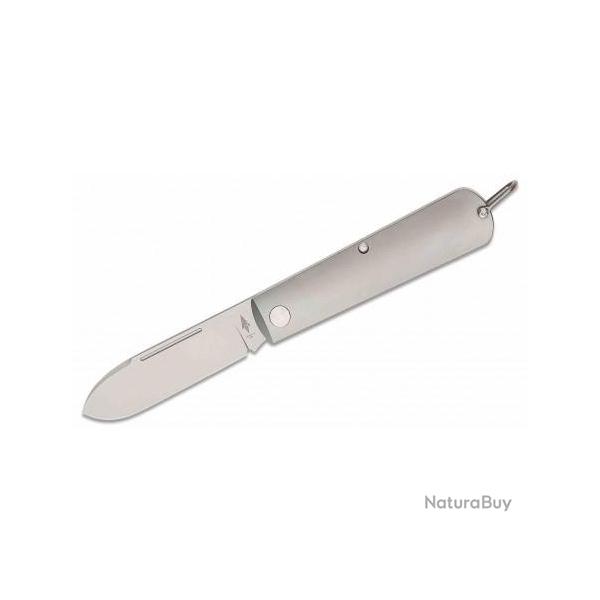
TER10701 Terrain 365 Otter Slipjoint Terravantium Dendritic Cobalt Spear Point Blade TER10701
Référence : TER10701 / Reference: TER10701
TER10701 Terrain 365 Otter Slipjoint Terravantium Dendritic Cobalt Spear Point Blade Titanium Handles
The Terrain 365 Otter Slipjoint is a modern, technical iteration of the classic Barlow pattern featuring their rustproof, edge-holding Terravantium blade. Like its animal namesake, this pocket knife is equally at home in the water or on land and is also available with carbon fiber, black or marine gray G10 scales.
The Barlow pattern is one of the most enduring classic slipjoint models ever created. Its appeal is in its simplicity, pragmatism, and usability. Terrain 365 looked to this great classic to create their own modern version. One of the unique carryovers is the lanyard bail where a leather wrist thong or knotted lanyard can be attached. The Otter Slipjoint is an all-around pocket knife for everyday carry, updated with technical, modern materials, precision machined parts, and a legacy design distilled down to its core characteristics that are utterly relevant today as it was when first introduced in 1670.
Features
Modern Modified Spear Point Blade Profile
Rustproof & Non-Magnetic Terravantium Blade
316 Stainless Steel Dive Watch Grade Hardware
Martensitic Stainless Steel Backspring
Fine Matte Finish
Dual Nail Nicks
Titanium Lanyard Bail (Do Not Close Blade with Bail Over Blade Channel)
Terrain 365 Mark
Terravantium Blade Mark
Specifications
Blade Length: 7.62cm
Closed Length:10.16cm
Overall Length: 17.62cm
Blade Material: Terravantium Dendritic Cobalt
Blade Thickness: 2.92mm
Blade Style: Spear Point
Blade Grind: Flat
Blade Finish: Bead Blast
Handle Material: 6Al4V Titanium
Handle Thickness: 1.14cm
Locking Mechanism: Slipjoint
Pivot Assembly: Bronze Bushings
Pocket Clip: None
Weight: 3.1 oz.
Designers: Mike Vagnino and Patrick Ma
Assembled in China from American and Japanese Parts